
Choosing a hospital bed often starts with visible specifications such as electric functions, side rails, casters, and load capacity. However, the mattress platform is just as important because it supports the mattress and moves with the bed. If its dimensions, structure, ventilation, or articulation are poorly matched to the application, positioning, cleaning, comfort, and long-term use may all be affected.
The mattress platform matters because it supports the mattress, transfers load to the bed frame, and follows the bed’s positioning functions. Its design can affect mattress stability, patient positioning, ventilation, cleaning access, durability, and compatibility with side rails and mattress dimensions. The best platform is not simply the strongest one; it should match the intended bed functions, mattress, patient group, and care environment.
Looking beyond motor count and appearance reveals important differences between hospital beds. The mattress platform is one of the best places to start.
What Is the Mattress Platform on a Hospital Bed?
The mattress platform, also called the mattress deck or sleeping platform, is the part of the bed directly underneath the mattress. It differs from the main frame: the frame provides overall structural support, while the platform creates the surface on which the mattress rests and normally contains the sections that move during adjustment.
On manual and electric beds, the platform may be divided into sections that create backrest, knee, or leg positioning.
The platform is part of the complete bed system
A hospital bed should be evaluated as a system rather than as separate parts. FDA guidance emphasizes the relationship among the bed frame, mattress, rails, and openings because gaps within the complete system can create entrapment hazards. Mattress size and fit therefore cannot be separated from the structure supporting it.
For buyers, external dimensions are not enough. Deck dimensions, recommended mattress size, rail configuration, and mattress position should also be confirmed.
How Does Platform Design Affect Patient Positioning?
The mattress platform allows the bed to change patient position while the mattress follows the moving sections.
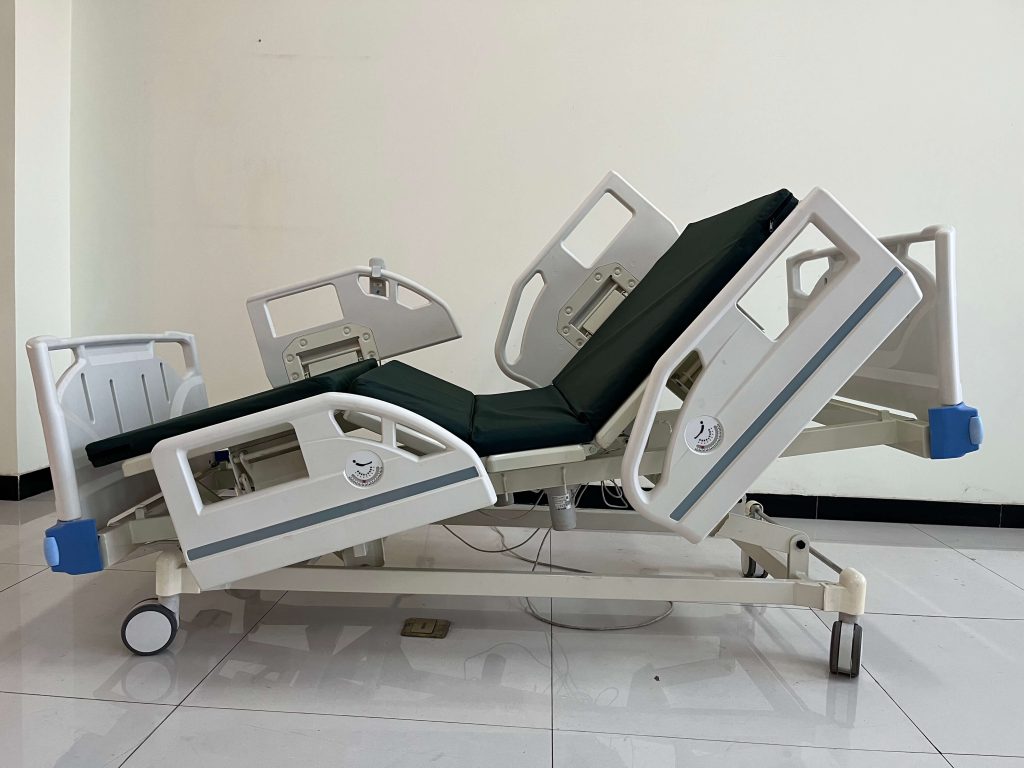
When the back section rises, the mattress must follow smoothly. When the knee or leg section changes angle, the mattress must flex with it. Suitable section lengths, hinge positions, and movement ranges help the mattress follow the bed without excessive bunching or sliding.
Articulated sections determine how the mattress moves
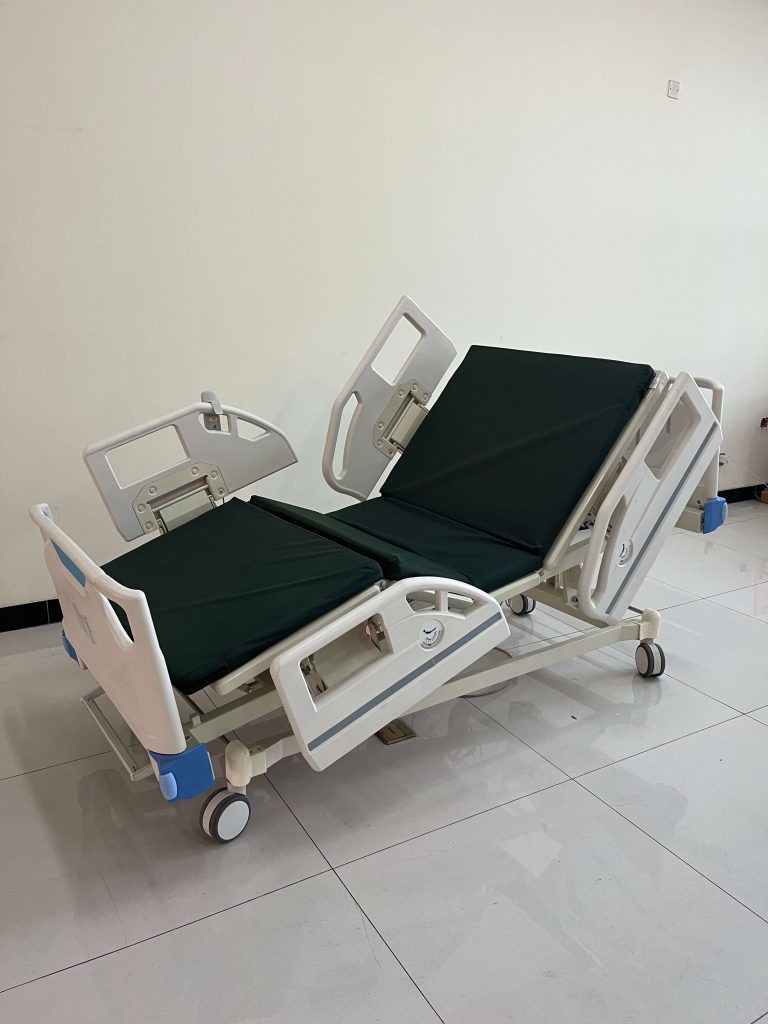
In a multi-function bed, the platform is normally divided into articulated sections supporting different areas of the body. However, the number of sections alone does not determine quality.
What matters is how the sections work together. Buyers should evaluate deck articulation together with backrest angle, leg adjustment, bed height, and mattress type.
Why Is Mattress Stability Important?
The mattress should remain centered during normal use and adjustment. Platforms may use raised edges, corner retainers, stops, or recessed areas to control movement, and these features should match the selected mattress.
Mattress retainers are small but important
Mattress retainers become particularly useful when the backrest is frequently raised. Repeated articulation and gravity can encourage some mattresses to move, especially when the mattress cover and platform have relatively low friction.
Buyers should check that retainers suit the mattress dimensions without making removal or cleaning unnecessarily difficult.
How Can Platform Design Influence Bed-System Safety?
Hospital-bed safety involves more than frame strength. Openings and gaps around the mattress, side rails, headboard, footboard, and deck can also matter.
FDA guidance identifies potential entrapment zones in hospital bed systems and recommends assessing the complete combination of components. It also advises checking the mattress, frame, and rails for gaps that could allow entrapment.
Because the deck determines where the mattress sits, poor fit or retention can change gaps around adjacent components.
Mattress compatibility matters more than nominal bed width
A buyer may see a familiar width and assume any similarly sized mattress will fit. In practice, length, width, thickness, compressibility, edge construction, and rail geometry should all be considered.
FDA materials specifically note that the bed frame, rail, and mattress should be evaluated together for gaps and possible entrapment areas. For B2B purchasing, requesting the manufacturer’s recommended mattress specification is therefore safer than selecting a mattress only from the bed’s external dimensions.
Why Do Ventilation Holes or Openings Matter?
Many mattress platforms are not completely solid. They may use punched holes, slots, molded openings, or spaced support elements.
These openings can allow airflow beneath the mattress and provide access for cleaning or inspection.
However, more openings do not automatically mean a better platform. Hole size, spacing, edge finish, reinforcement, and the mattress above the deck all matter. The deck still needs to provide stable and reasonably uniform support.
Ventilation does not replace mattress hygiene
A ventilated platform can support airflow, but it should not be treated as a complete moisture-management or infection-control solution. Mattress cover condition, cleaning procedures, room conditions, and mattress construction remain important.
The FDA notes that hospital mattress covers are intended to prevent blood and other body fluids from entering the mattress core. Platform ventilation is therefore a useful design feature, not a substitute for a suitable medical mattress and proper cleaning procedures.
How Does the Platform Affect Cleaning and Maintenance?
Hospital beds are cleaned repeatedly, so deck geometry can influence how convenient routine cleaning becomes.
Smooth surfaces, accessible corners, limited dirt traps, and removable panels may make inspection and wiping easier. Complicated joints or deep recesses may require more effort. Cleaning methods must still follow the manufacturer’s instructions; for example, Hillrom warns against steam cleaning or power washing one of its hospital-bed systems because excessive pressure and moisture can damage surfaces.
Removable panels can simplify servicing
On some beds, parts of the platform can be removed without dismantling the complete frame. This can make it easier to clean underneath the deck, inspect mechanisms, or replace a damaged section.
For overseas distributors, replaceable panels and service parts can reduce maintenance difficulty over the product’s life.
Does the Platform Material Make a Difference?
Common platform designs include punched or formed steel surfaces and molded polymer panels. Some beds also combine metal structural components with polymer deck sections.
Steel can provide a rigid and durable support surface and is common in practical manual or semi-electric beds. Molded polymer panels can offer smooth contours, integrated openings, and modular removal. Neither material is automatically superior for every application.
Buyers should compare construction, not only material names
A specification saying “steel platform” or “ABS platform” tells only part of the story. Buyers should also consider forming method, coating quality, reinforcement, edge finish, panel attachment, rib structure, and resistance to repeated cleaning.
For wholesale sourcing, detailed photos, specifications, spare-part information, and test documents can reveal more than a material label.
How Does the Platform Contribute to Load Support and Durability?
The mattress platform receives patient load and transfers it into the main bed structure. During articulation, these forces also pass through hinges, linkages, actuators or cranks, and the frame.
Platform stiffness and reinforcement matter because excessive deformation can affect mattress support, movement, noise, and durability.
Evaluate the load rating of the complete bed
Buyers should review the manufacturer’s stated safe working load or applicable maximum load and understand how the complete bed model has been tested. The platform should not be evaluated in isolation.
IEC 60601-2-52 addresses basic safety and essential performance requirements for medical beds, and the FDA currently lists the standard among its recognized consensus standards.
A thick-looking deck does not automatically mean a higher usable load; ask for specifications for the complete bed.
Can Platform Geometry Affect Comfort?
The mattress is the primary patient-contact surface, so comfort and pressure management depend strongly on mattress selection. Still, the platform beneath it influences how the mattress behaves.
A stable, correctly segmented deck gives the mattress a predictable foundation. Uneven support, sharp transitions, large unsupported areas, or poor hinge geometry can change the way the mattress flexes when the bed moves.
The bed deck and mattress should be specified together
Standard and specialty mattresses can have different requirements for deck width, retention, articulation, and clearance. Matching the bed and mattress during specification can reduce fit and performance problems later.
What Should Hospital-Bed Buyers Check Before Ordering?
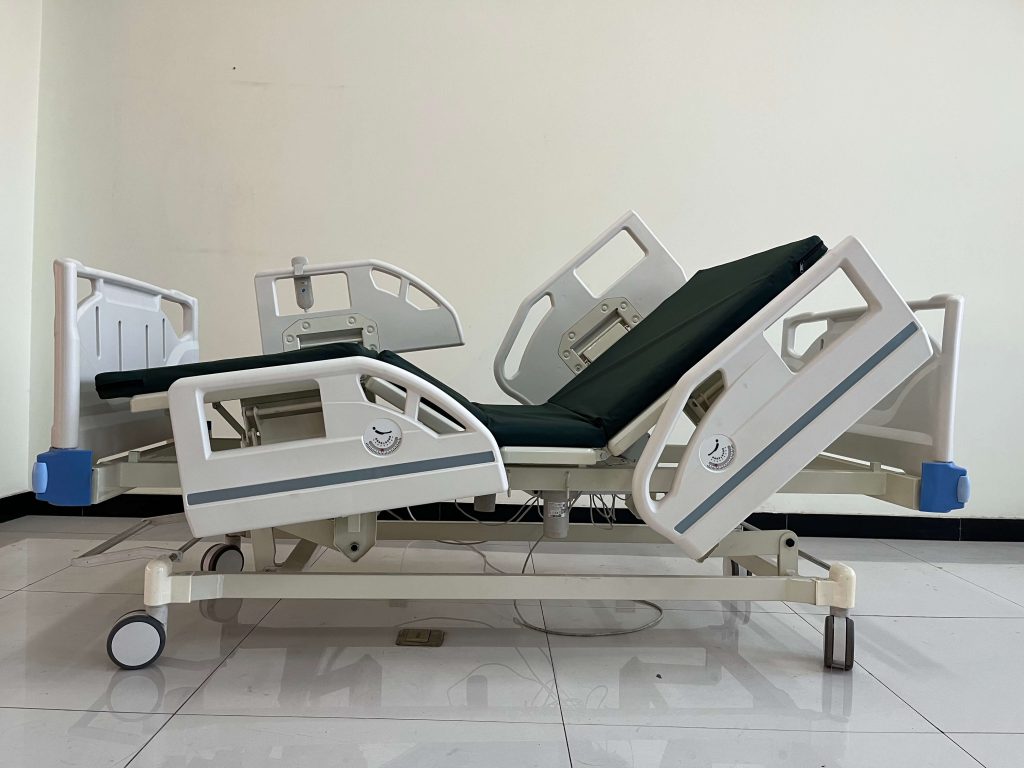
A useful purchasing specification should go beyond platform material. Buyers should confirm usable deck dimensions, articulated sections, platform material and finish, recommended mattress size and thickness, mattress-retention method, ventilation design, cleaning method, panel removability, side-rail compatibility, and load specification.
Photos or videos with the mattress removed can reveal hinges, reinforcement, openings, mattress stops, and cleaning access. For larger orders, samples or pre-shipment inspections can also include deck dimensions and function checks.
Why Should Platform Design Be Included in an RFQ?
Many hospital-bed RFQs focus heavily on motors, side rails, casters, headboards, functions, and price. Adding mattress-platform requirements makes quotations more precise.
It gives suppliers clearer expectations about dimensions, materials, removable sections, ventilation, and mattress compatibility, helping buyers distinguish products that look similar in catalogs.
For distributors, this is especially valuable when comparing several factories. A basic ward bed may prioritize durable construction, simple maintenance, and cost efficiency, while a higher-function electric bed may emphasize modular panels, more complex articulation, and easier servicing.
How Does Jcare Approach Hospital Bed Platform Selection?
Jcare supplies hospital beds, home-care beds, rehabilitation products, medical furniture, and bed accessories for B2B customers. Different markets require different levels of functionality, so mattress-platform design should be matched to the intended application rather than treated as a cosmetic detail.
For a cost-sensitive ward project, buyers may prioritize straightforward construction, durability, ventilation, and practical maintenance. For electric or higher-function beds, articulation, modularity, mattress retention, and ease of cleaning may receive greater attention.
Jcare works with hospitals, private clinics, distributors, medical-bed purchasers, and home-care bed buyers. Platform dimensions, mattress matching, bed functions, accessories, packaging, and order requirements can be discussed before production, helping buyers compare specifications more clearly before placing volume orders.
Conclusion
The mattress platform is easy to overlook because it is largely hidden after the mattress is installed. Yet it influences how the bed supports the mattress, changes position, handles load, controls mattress movement, allows cleaning, and works with side rails and other components.
There is no single platform design that is best for every hospital bed. Buyers should choose according to the intended patient group, mattress, bed functions, cleaning routine, maintenance needs, and destination-market requirements.
If you are sourcing hospital beds for a hospital project, distributor network, clinic, or home-care product line, Jcare can help review bed configurations and mattress-platform options according to your purchasing requirements. Contact Jcare at jcarebed@gmail.com for wholesale inquiries, customization, and product matching.