
Hospital bed buyers often ask why some beds move smoothly through corridors while others feel heavy, unstable, or difficult to steer. Poor mobility can increase staff effort and complicate transfers through doorways, elevators, and crowded wards. Understanding casters, steering, brakes, dimensions, and frame design helps buyers choose beds that are easier to transport.
A hospital bed is easy to move between rooms when it combines smooth-rolling casters, reliable steering, effective brakes, balanced weight distribution, suitable overall dimensions, and convenient push points. Buyers should also consider floor conditions, doorway width, elevators, patient load, and attached accessories. Good mobility depends on the entire bed design, not simply the number or size of its wheels.
Hospital bed mobility involves several connected design factors. Understanding each one makes supplier comparison and purchasing decisions much easier.
Why Is Hospital Bed Mobility Important?
Hospital beds are rarely judged only by how comfortable they are when stationary. In many facilities, beds must also move between patient rooms, treatment areas, elevators, examination spaces, recovery areas, cleaning zones, and storage locations.
A bed that is difficult to push may require more effort from hospital staff. It may also be harder to turn in narrow corridors or position accurately beside other equipment.
For this reason, mobility should be evaluated as part of normal hospital workflow.
The importance of mobility becomes even greater in large hospitals where beds may travel significant distances every day. Emergency departments, surgical wards, intensive care areas, and general inpatient departments can all require frequent bed movement.
However, the right mobility configuration depends on how the bed will actually be used. A bed that remains mainly inside one room does not necessarily need the same steering system as a bed that regularly travels between departments.
What Caster Features Make a Hospital Bed Easier to Move?
Casters are among the most important components affecting hospital bed movement.
However, buyers should not evaluate them only by asking how many wheels a bed has. Caster diameter, tread material, bearings, swivel performance, mounting quality, braking system, and steering configuration can all influence mobility.
A good caster system should help the bed start moving smoothly, travel predictably, turn when required, and stop securely.
Smooth Rolling Reduces Pushing Effort
Rolling resistance affects how much force is needed to start and continue moving the bed.
When a hospital bed carries a patient, mattress, bedding, IV pole, and other accessories, the total weight can be significantly greater than the empty bed used in a showroom demonstration.
Therefore, buyers should consider how the casters perform under realistic loading conditions.
Well-designed casters with appropriate bearings and tread materials can make movement feel more controlled. Poor-quality wheels may become harder to rotate, develop noise, or require more frequent maintenance after extended use.
For hospitals buying beds in bulk, these differences can affect long-term usability.
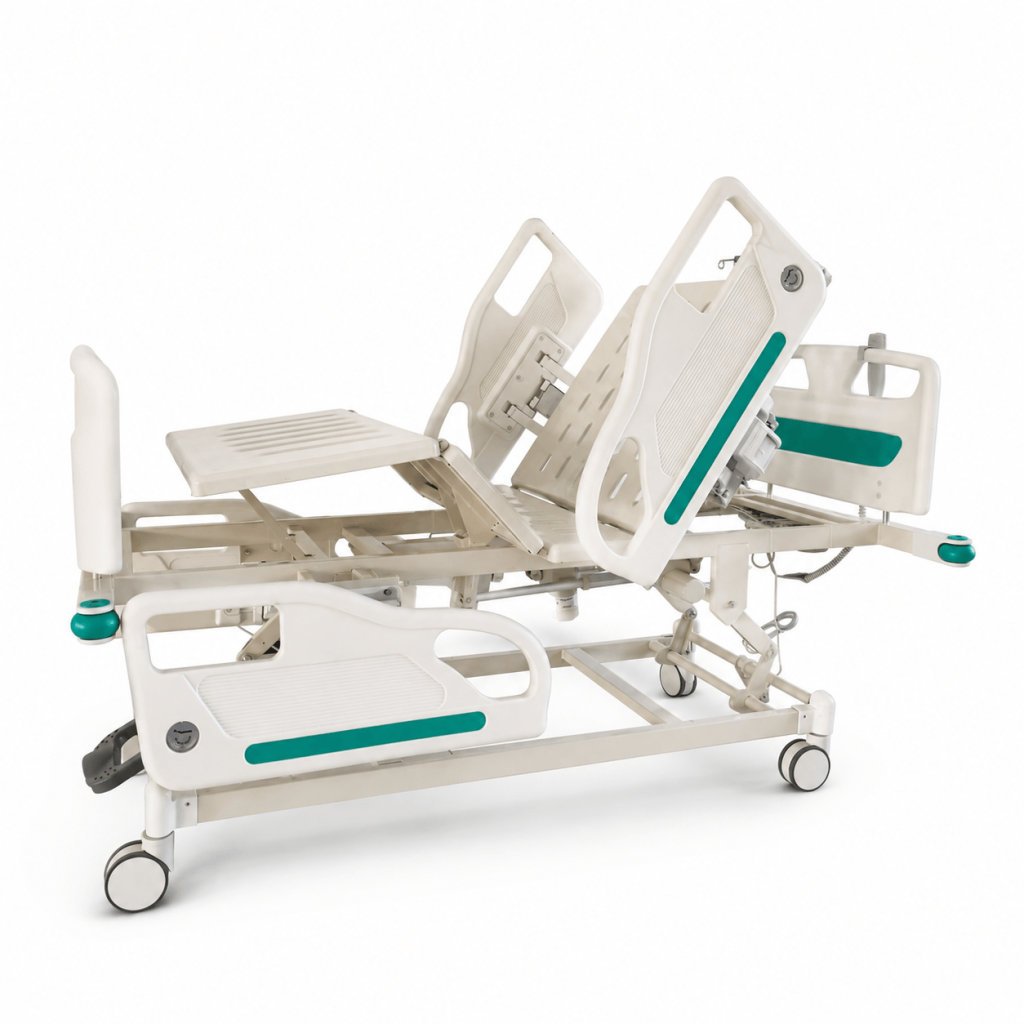
Does Caster Size Affect Hospital Bed Mobility?
Yes. Caster diameter can influence how easily a hospital bed travels across the floor.
Larger-diameter wheels generally pass over small floor joints, elevator gaps, minor thresholds, and surface irregularities more easily than very small wheels. They can therefore be useful when beds are moved frequently between different rooms and departments.
However, bigger is not automatically better.
Caster size must work with the bed’s chassis, braking system, lifting mechanism, under-bed clearance, and overall design.
For procurement teams, the better approach is to evaluate the complete caster system rather than choosing a bed simply because it has larger wheels.
Hospitals should also consider their own flooring. Smooth vinyl floors, tile, transitions between floor materials, and elevator entrances may create different mobility requirements.
A supplier demonstration on flooring similar to the final installation environment can provide more useful information than caster diameter alone.
Why Is Swivel Performance Important?
A hospital bed must perform two different movements well.
First, it should move in a reasonably straight line along corridors. Second, it should be able to turn and reposition inside patient rooms.
These requirements can conflict.
If every wheel swivels freely, a bed may be highly maneuverable in a small space, but staff may need to make frequent steering corrections during long-distance transport.
This is why steering design matters.
Directional Control Helps Beds Travel Straight
Some hospital beds include a directional-lock function that keeps one caster, or part of the steering system, aligned with the direction of travel.
This can improve straight-line control in corridors.
When the bed enters a patient room, the directional function can be released so the wheels swivel freely again, making tight turns and bedside positioning easier.
For hospitals where staff frequently transport patients between departments, this combination of straight tracking and low-speed maneuverability can be particularly useful.
Buyers should ask suppliers exactly how the steering mechanism works and whether staff can activate it easily.
How Does a Central Locking System Improve Mobility?
Mobility is not only about moving a hospital bed. Staff also need to stop and secure it efficiently.
Beds with individual caster brakes require staff to operate separate brake mechanisms. This may be acceptable for simpler beds, especially when they are rarely moved.
However, beds designed for frequent clinical use may benefit from a central locking system.
A central braking mechanism allows several casters to be controlled through linked pedals or controls. Depending on the design, different positions may provide free movement, directional steering, or braking.
This can make the bed easier to manage during routine transportation.
Brake Accessibility Matters
The presence of central locking alone does not guarantee good usability.
Buyers should examine whether staff can reach the brake pedals easily from normal working positions. Pedal operation should also be clear and predictable.
During product evaluation, procurement teams can check:
- How much force is needed to operate the brake
- Whether the brake engages positively
- Whether controls are easy to identify
- Whether staff can reach them from both sides
- Whether the mechanism remains stable after repeated use
- Whether replacement parts are available
Simple operation is especially important in busy hospital environments.
Do Hospital Bed Dimensions Affect Room-to-Room Movement?
Yes. Overall bed dimensions strongly influence mobility.
Buyers often focus on mattress platform size because it determines the patient sleeping area. However, the complete external width may be greater because of side rails, bumpers, controls, handles, and other structural components.
This external width determines whether a bed can pass comfortably through hospital doors.
Buyers Should Check More Than Door Width
A bed may technically fit through a doorway while still being inconvenient to move.
For example, if only a very small clearance remains on each side, staff may repeatedly contact door frames or have difficulty correcting the bed’s direction.
Before placing a bulk order, buyers should compare complete bed dimensions with:
- Patient room doors
- Ward entrances
- Elevator doors
- Elevator interiors
- Corridor widths
- Treatment rooms
- Storage areas
- Narrow intersections
The same principle applies to overall bed length.
A longer bed may require more space to turn inside an elevator or around a corridor corner. Therefore, external width, total length, and turning behavior should be considered together.
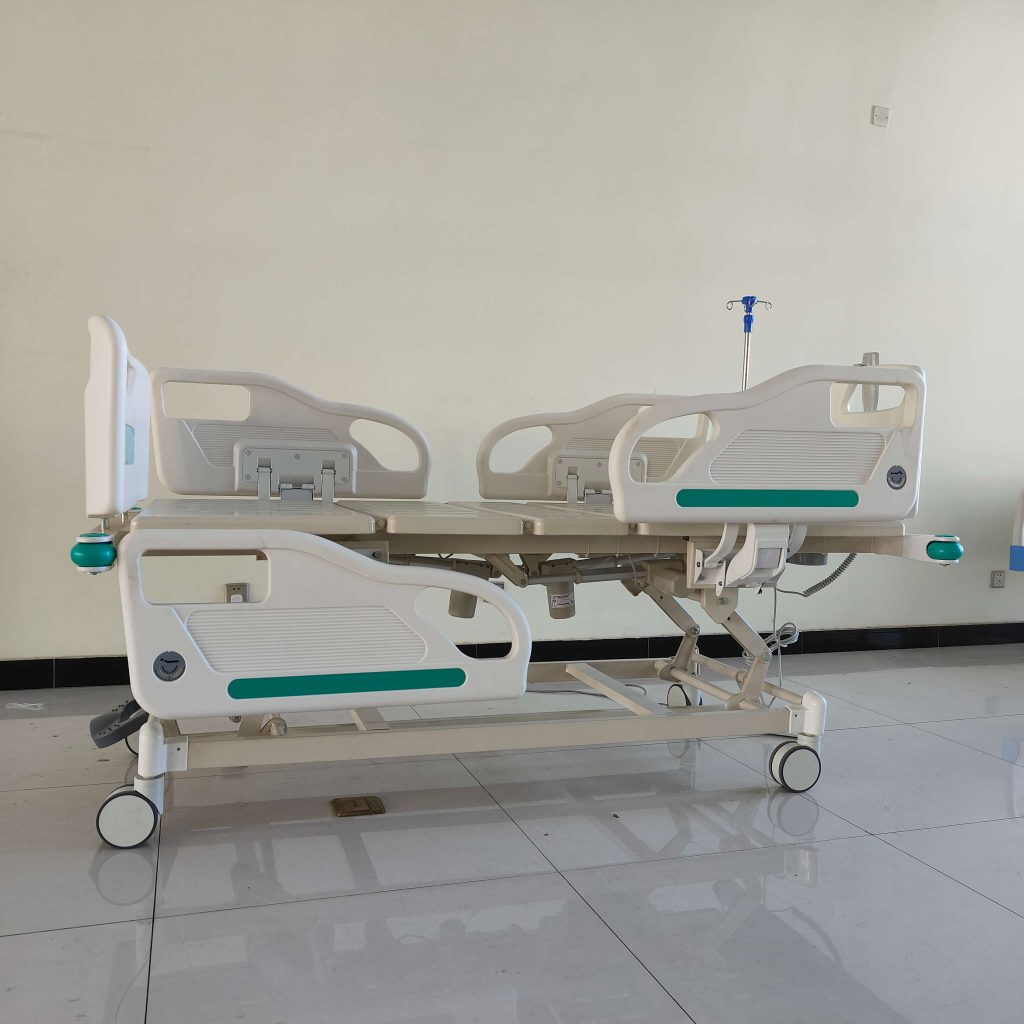
What Makes a Hospital Bed Easy to Turn?
Turning performance depends on caster position, wheelbase, bed length, chassis geometry, and steering configuration.
A hospital bed that moves smoothly in a straight line may still feel difficult to rotate in a narrow room if its turning characteristics are poorly matched to the facility.
Buyers should therefore evaluate turning radius during product testing.
A useful mobility test can include entering a patient room, rotating the bed near a wall, passing through a narrow doorway, making a 90-degree corridor turn, and entering an elevator.
These movements are often more informative than simply pushing an empty bed forward in a showroom.
Hospitals with limited space should pay particular attention to this issue because maneuverability can affect everyday positioning around bedside cabinets, monitoring equipment, and other furniture.
How Do Weight and Balance Affect Hospital Bed Movement?
Hospital beds contain many components, including the steel frame, bed platform, side rails, headboard, footboard, actuators, batteries, controls, and accessories.
The location of these components influences weight distribution.
Balanced weight distribution can help the bed feel more predictable when staff push or turn it. Poor balance may make one end feel heavier or cause the bed to respond unevenly during directional changes.
Patient weight also changes handling characteristics.
This is why mobility should not be assessed only when the bed is empty.
Loaded Testing Gives Buyers Better Information
During supplier evaluation, buyers can place a representative test load on the bed and repeat common transport movements.
The goal is not simply to determine whether the bed can support the load. That information belongs to the bed’s rated capacity.
Instead, the purpose is to see whether the caster system, steering, and brakes remain manageable when the bed is being used more realistically.
For large procurement projects, this kind of testing can reveal differences between models that appear almost identical in a catalog.
Why Do Push Handles and Bed End Design Matter?
Hospital staff need suitable contact points for controlling a moving bed.
Depending on the design, they may push from the headboard, footboard, integrated handle, or another dedicated grip.
The pushing position should provide enough leverage to control the bed without forcing staff into an awkward posture.
Handle placement can also affect visibility when entering corridors, elevators, or patient rooms.
Buyers should check whether side rails, IV poles, control panels, or other accessories interfere with the normal pushing position.
The headboard and footboard should also remain secure while the bed is being transported.
If detachable components are used, their locking structure should prevent unwanted movement during normal handling.
Do Bumpers Help Hospital Beds Move Between Rooms?
Protective bumpers can make room-to-room transportation more practical, especially in narrow environments.
They do not reduce rolling resistance, but they can help protect the bed and surrounding surfaces from minor contact.
Door frames, corridor walls, furniture, and elevator interiors can all be exposed to occasional impacts when beds are turned or positioned.
Well-positioned corner bumpers can reduce direct contact between the metal frame and nearby surfaces.
However, buyers should also consider the external dimensions created by the bumpers.
If they extend significantly beyond the bed frame, they may increase the total width. Procurement teams should therefore check the complete bed size with all standard protective components installed.
How Do Accessories Affect Hospital Bed Mobility?
A hospital bed that is easy to move in its basic configuration may behave differently once accessories are attached.
IV poles, urine bag hooks, oxygen-cylinder holders, monitors, mattresses, cables, storage devices, and other equipment can affect weight, balance, width, and clearance.
Accessories that extend outside the bed frame may also catch on doorways or nearby equipment.
For this reason, buyers should evaluate the bed in the configuration that will actually be used.
Questions may include whether the IV pole remains stable during transport, whether drainage bags stay clear of the wheels, and whether cables can be organized without reaching the floor.
Accessory layout becomes particularly important in departments where the patient and several pieces of equipment may be transported together.
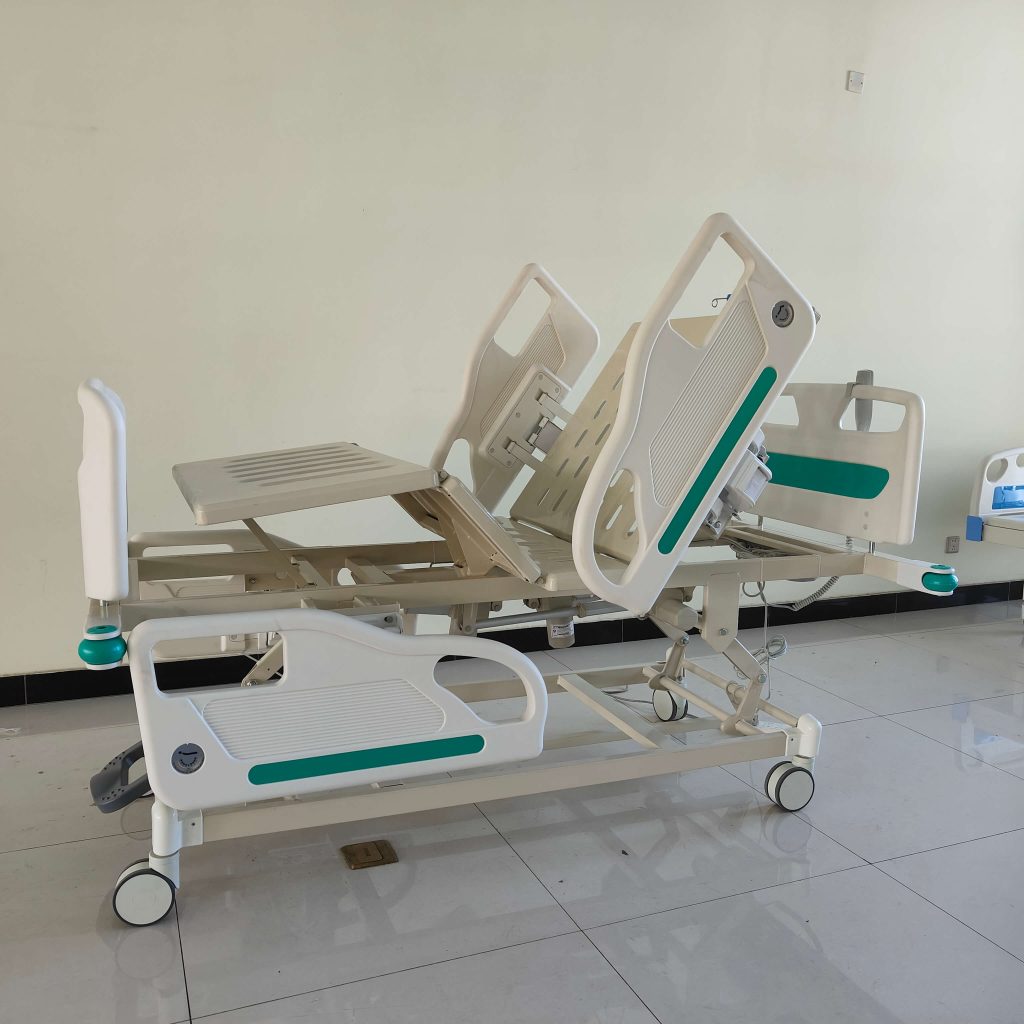
Do Hospital Floors Affect Bed Mobility?
Yes. The same hospital bed can feel different on different surfaces.
Smooth hospital flooring normally provides relatively low rolling resistance, but beds may still encounter joints, elevator entrances, ramps, small thresholds, and transitions between floor materials.
Floor contamination can also influence caster performance over time.
Dust, hair, cleaning residue, and other debris can accumulate around wheels and bearings if the caster design is difficult to clean.
Hospitals should therefore consider both immediate mobility and long-term maintenance.
Caster assemblies should be accessible enough for inspection and cleaning. Replacement wheels and brake components should also be available when required.
For distributors and large hospital projects, spare-part support can become an important part of the total purchasing decision.
How Should Buyers Test Hospital Bed Mobility?
Hospital bed mobility should ideally be evaluated through a practical demonstration.
A simple test route can provide useful information about how the bed performs under normal working conditions.
Buyers can evaluate:
Starting movement: Does the bed begin rolling smoothly?
Straight tracking: Can it travel down a corridor without constant correction?
Turning: Can staff make controlled turns in limited space?
Doorways: Is there enough clearance to pass comfortably?
Elevators: Can the bed enter, position, and exit easily?
Braking: Does the bed stop securely?
Repositioning: Can staff make small adjustments beside the bed space?
Noise: Do the casters or frame create excessive sound?
Loaded handling: Does movement remain manageable with a representative load?
Testing more than one model under the same conditions can make supplier comparison much easier.
What Should Buyers Ask a Hospital Bed Supplier?
Product catalogs may not provide enough information to judge real-world mobility.
Before ordering, procurement teams can ask suppliers several practical questions:
- What caster diameter is used?
- What wheel material is supplied?
- Does the bed use individual or central locking?
- Is directional steering available?
- What is the complete external width?
- What is the total bed length?
- Are protective bumpers included?
- Can casters be replaced individually?
- Are spare brake components available?
- Can the bed be demonstrated under load?
- Can caster specifications be customized?
- How should the wheel system be maintained?
These questions are especially valuable for hospitals, distributors, private clinics, and medical equipment purchasers comparing bulk quotations.
Price remains important, but mobility, maintenance, replacement parts, and staff usability can also affect the long-term value of the bed.
Как компания Jcare может оказать поддержку в реализации проектов по закупке больничных коек?
Different hospitals may require different bed configurations depending on ward layout, transport frequency, patient requirements, and budget.
Компания Jcare поставляет больничные кровати, кровати для ухода на дому, реабилитационное оборудование, медицинскую мебель и аксессуары для медицинских кроватей для оптовых закупок и закупок в рамках проектов.
For B2B buyers, specifications such as caster configuration, braking systems, bed dimensions, side rails, accessories, packaging, quantities, and customization requirements can be discussed before ordering.
This allows hospitals, clinics, distributors, and medical bed purchasers to compare configurations based on their actual project rather than relying only on standard catalog descriptions.
Factory-direct sourcing can also simplify communication about bulk orders, production requirements, replacement components, packaging, and delivery schedules.
Заключение
A hospital bed becomes easier to move between rooms when its casters, steering system, brakes, frame dimensions, weight distribution, push points, bumpers, and accessories work together effectively.
Buyers should avoid evaluating mobility by wheel size alone. Corridor width, doorways, elevators, flooring, patient loads, transport frequency, and maintenance requirements can all affect real-world performance.
Practical testing is one of the best ways to compare different hospital bed models before a bulk purchase.
For hospitals, private clinics, distributors, and medical bed purchasers, selecting the right mobility configuration can make everyday transportation more predictable and convenient while supporting smoother hospital workflows.
If you have experience comparing hospital bed mobility features, share your thoughts or questions in the comments. You can also share this guide with colleagues involved in hospital bed purchasing or medical equipment sourcing. For wholesale hospital bed specifications or customization inquiries, contact Jcare at jcarebed@gmail.com.