
Hospital buyers often ask which bed functions matter most in respiratory wards and whether electric models are always necessary. Choosing poorly can make repositioning, cleaning, transfers, and equipment management less efficient. A better approach is to match positioning, safety, mobility, hygiene, and accessory features to the ward’s actual workflow.
Hospital beds for respiratory wards should prioritize adjustable backrest positioning, practical height control, stable side rails, reliable casters and brakes, easy-to-clean surfaces, and compatibility with IV poles and bedside equipment. Electric beds are generally more suitable where frequent repositioning is expected, while manual or semi-electric models may fit lower-acuity areas. Buyers should choose functions according to patient acuity, nursing workflow, cleaning requirements, maintenance capacity, and total procurement budget.
The best bed is not simply the model with the most functions. Buyers should compare each feature according to how the respiratory ward actually operates.
Why Do Respiratory Wards Need Different Hospital Bed Features?
Respiratory wards may care for patients who need oxygen therapy, close observation, frequent position changes, non-invasive respiratory support, or more intensive monitoring. As a result, positioning and bedside access can become especially important.
For procurement teams, the first step is to separate essential functions from optional ones. Beds can then be matched to patient acuity, positioning frequency, and bedside equipment needs.
Positioning Should Match Respiratory Care Workflow
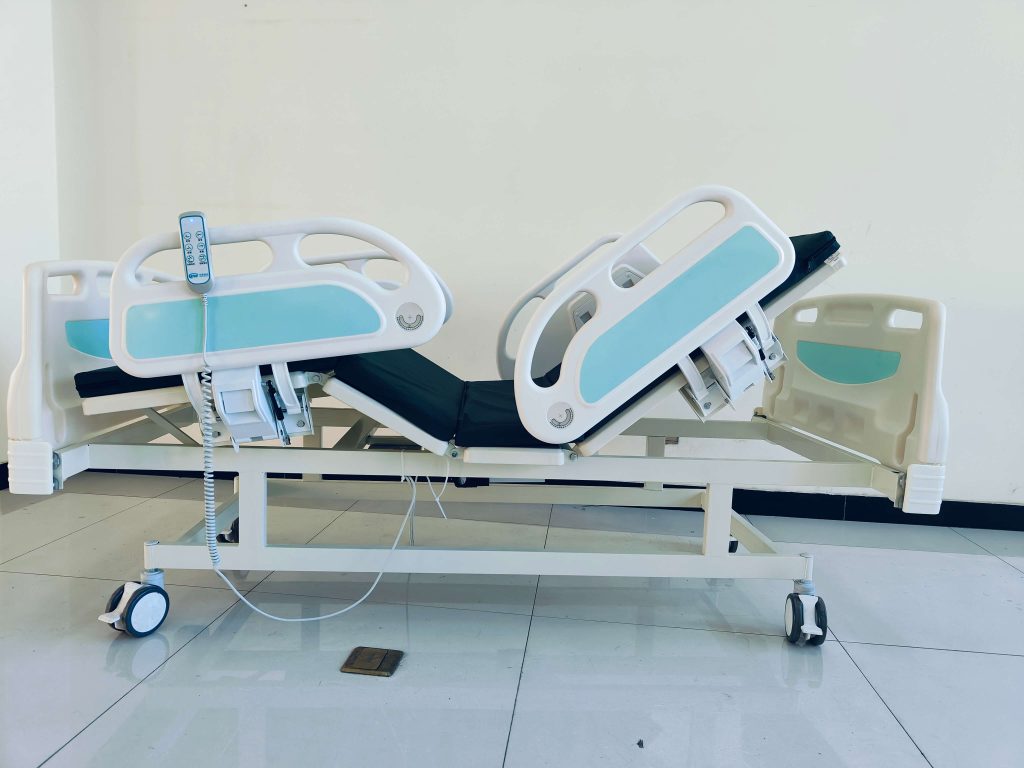
Backrest adjustment is usually one of the first functions to evaluate. Raising the upper body gives staff more flexibility when positioning patients. For mechanically ventilated patients, AHRQ notes that semirecumbent head-of-bed elevation of at least 30 degrees is associated with lower aspiration and ventilator-associated pneumonia risk.
Buyers should also consider adjustment range, operating method, movement stability, control accessibility, and suitability for repeated use.

What Bed Adjustments Matter Most in Respiratory Wards?
The required adjustment package depends on the respiratory department. A general ward may need fewer functions than a high-dependency area.
Backrest and Height Adjustment Are Core Functions
A suitable bed should provide a practical backrest range. Electric adjustment is useful when position changes are frequent because it reduces repeated manual crank operation. Manual adjustment can still work well in lower-acuity wards.
Whole-bed height adjustment can also improve access during nursing, linen changes, examinations, and transfers. FDA bed-safety guidance recommends beds that can be raised and lowered to accommodate patient and healthcare-worker needs.
Buyers should compare minimum and maximum platform height and remember that mattress thickness changes the final working height.
Are Trendelenburg Functions Necessary?
Trendelenburg and reverse Trendelenburg may be useful in some departments, but they should not automatically be specified for every respiratory bed.
Buyers should ask clinicians whether these positions are routinely required. If they are rarely used, a simpler configuration may provide better value.
Should Respiratory Wards Choose Electric or Manual Beds?
Both electric and manual beds can be appropriate. Their best applications are simply different.
When Electric Hospital Beds Make More Sense
Electric beds are often preferable when staff repeatedly adjust the backrest, leg section, or bed height. Depending on the model, electric operation may include backrest elevation, leg positioning, height control, Trendelenburg, and reverse Trendelenburg.
Buyers should also ask about motors, controls, battery-backup options, voltage, plug type, spare parts, and replacement procedures. For export orders, parts availability is especially important.
When Manual Beds Are Still Practical
Manual hospital beds remain useful for lower-acuity respiratory wards, budget-sensitive projects, or facilities that prefer simpler maintenance.
A crank system can provide essential adjustment without motors or electronic controls. Some hospitals may achieve better value through a mixed configuration: electric beds in higher-acuity rooms and manual or simpler adjustable beds where frequent powered positioning is unnecessary.
How Important Are Side Rails and Bed Safety?
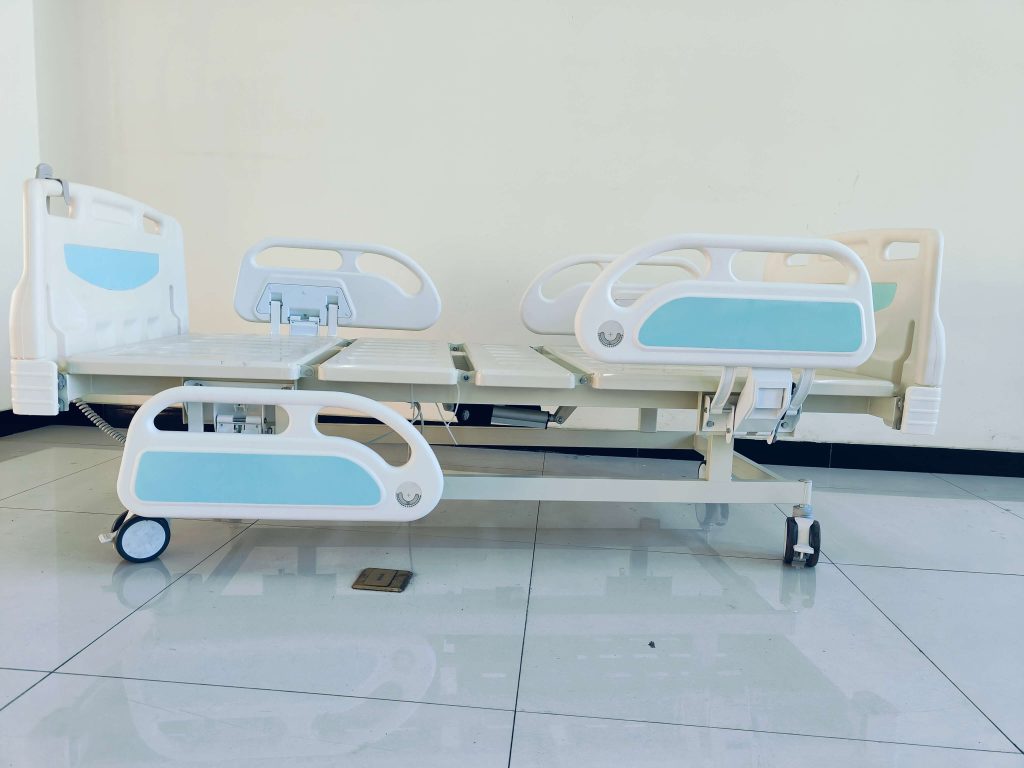
Side rails should be evaluated as part of the complete bed system. Mattress thickness, rail height, gaps, locking mechanisms, and patient characteristics all affect practical safety.
FDA guidance treats the bed as a system that includes the frame, mattress, rails, and compatible accessories, and it highlights entrapment risks associated with inappropriate gaps.
Check Rail Locks and Mattress Compatibility
Buyers should confirm that rails lock securely, release conveniently, and remain at an appropriate height after the selected mattress is installed.
A different mattress thickness can change the relationship between the sleeping surface and the side rail. Beds and mattresses should therefore be specified together rather than purchased as unrelated components.
Hospitals can also compare full-length and segmented rails according to access requirements, patient population, and local policies.
Why Do Casters and Brakes Matter?
Respiratory ward beds may need to move for cleaning, transfers, equipment access, or room reorganization. Caster quality therefore affects daily usability.
Buyers should compare caster diameter, rolling smoothness, noise, locking reliability, material, and replacement availability. Central-locking systems can be convenient in busy wards, while individual locking casters may be sufficient for simpler or more price-sensitive projects.
When possible, purchasers should test mobility with the mattress installed rather than judging an empty display bed.
What Cleaning Features Should Respiratory Beds Have?
Hospital beds contain many frequently touched surfaces. CDC identifies bed rails and bed frames as high-touch surfaces and states that high-touch surfaces require more frequent and rigorous cleaning than low-touch surfaces.
For this reason, cleaning access should be considered during product selection.
Choose Accessible, Easy-to-Clean Structures
Buyers should inspect headboards, footboards, rails, bed platforms, frame corners, controls, caster housings, and accessory mounts.
Important questions include whether head and foot boards are detachable, whether deep gaps are difficult to reach, whether both sides of the rails are accessible, and whether damaged components can be replaced individually.
Purchasers should also ask about frame materials, surface treatment, and recommended cleaning agents so the hospital can compare the bed with its own cleaning procedures.
What Accessories Matter Around Respiratory Beds?
Respiratory patients may have IV lines, oxygen equipment, monitors, drainage systems, or other devices around the bed. Bed design should therefore support a practical bedside layout.
Check IV Pole and Accessory Compatibility
Buyers should compare IV pole material, hook quantity, mounting locations, stability, and replacement availability. Other useful features may include drainage-bag hooks, mattress retainers, accessory sockets, or oxygen-cylinder holders where required.
Preparing an accessory list before requesting quotations helps suppliers price the same configuration and makes comparisons more accurate.
It is also useful to ask whether accessories can be added later. Modular compatibility can make future ward upgrades easier.
How Should Buyers Evaluate the Mattress and Bed Platform?
The mattress and platform affect comfort, side-rail geometry, cleaning, and overall bed height. They should therefore be treated as part of the bed system.
Buyers should specify mattress dimensions, thickness, cover material, cleaning requirements, and whether specialty mattresses may be used. The bed platform should provide stable support, while mattress retainers should keep the mattress correctly positioned during adjustment.
If the hospital plans to source mattresses separately, it should provide the intended dimensions to the bed manufacturer before production.
What Should a Respiratory Ward Bed Specification Include?
A standardized specification sheet allows procurement teams to compare suppliers on the same basis. Without one, beds with similar names may differ significantly in functions and included components.
Build the Specification Before Comparing Prices
A practical specification can include:
- overall bed dimensions;
- mattress platform size;
- required load specification;
- backrest and leg adjustment ranges;
- bed-height range;
- Trendelenburg requirements;
- electric or manual operation;
- side rail design;
- caster size and braking method;
- IV pole and drainage hooks;
- mattress requirements;
- battery backup if needed;
- voltage and plug type;
- spare parts and optional accessories;
- packaging method;
- order quantity and delivery schedule.
Once these points are standardized, price differences are easier to understand.
How Should Buyers Compare Total Purchasing Value?
Unit price is important, but it should not be the only deciding factor.
The total purchasing value includes the bed, mattress, accessories, packaging, freight, spare parts, maintenance, and the operational effect of the selected configuration.
A low-priced bed can become expensive if casters, rails, crank systems, motors, or controls are difficult to replace. Conversely, a high-specification bed can provide poor value if the hospital pays for functions that staff rarely use.
Buyers should therefore compare manufacturing consistency, production capacity, lead time, spare-part availability, documentation, packaging, customization capability, and after-sales communication together with unit price.
How Should Hospitals Make the Final Choice?
The most suitable respiratory ward bed is the one that fits the department without adding unnecessary complexity.
Purchasing teams should involve nursing, clinical, maintenance, infection-control, and procurement staff. Each group can assess positioning, serviceability, cleaning access, logistics, and supplier reliability.
For larger orders, evaluating a sample before mass production can help staff check bed movement, rail operation, mattress fit, caster performance, cleaning access, and accessory compatibility.
Заключение
Choosing hospital beds for respiratory wards requires a balanced review of positioning, height adjustment, electric or manual operation, side rails, casters, cleaning access, mattress compatibility, accessories, maintenance, and total purchasing cost.
Backrest adjustment is usually a core requirement, while electric functions become more valuable when positioning is frequent. Manual beds can still be practical for lower-acuity or budget-sensitive areas. Rather than using one specification throughout the department, hospitals can match different bed configurations to different respiratory care needs.
Jcare supplies hospital beds, home care beds, rehabilitation products, other medical furniture, and medical bed accessories for wholesale and institutional projects. Buyers can discuss dimensions, functions, accessories, quantities, packaging, and delivery requirements according to their purchasing plans.
What features matter most when your hospital purchases respiratory ward beds? Share your experience in the comments, or send this article to colleagues preparing a hospital-bed procurement project.