
Hospital bed buyers often see an “accessory rail” listed in specifications but may not know exactly what it does. If this detail is ignored, important holders or equipment may not fit later. Understanding its purpose helps hospitals and distributors choose beds that support safer, cleaner, and more flexible bedside equipment organization.
An accessory rail on a hospital bed is a metal mounting rail used to attach compatible accessories such as drainage bag holders, cable hooks, baskets, equipment brackets, and other approved components. It provides a stable location for organizing equipment close to the bed without attaching everything directly to the main frame. Rail size, position, load capacity, and accessory compatibility vary by bed model, so buyers should confirm specifications before ordering.
The rail may look simple, but it affects workflow, compatibility, cleaning, and future replacement needs. The following sections explain what B2B buyers should check.
What Is an Accessory Rail on a Hospital Bed?
An accessory rail is usually a metal bar fixed to the side of the lower bed frame. Its main purpose is to provide a defined mounting point for accessories that need to remain close to the patient or bed.
Depending on the bed design, the rail may be installed on one side, both sides, near the head end, near the foot end, or along a longer section of the frame. Some beds use a simple rail with hooks, while others use a standardized-style rail for clamp-mounted accessories.
Accessory Rail vs. Side Rail
An accessory rail should not be confused with a side rail.
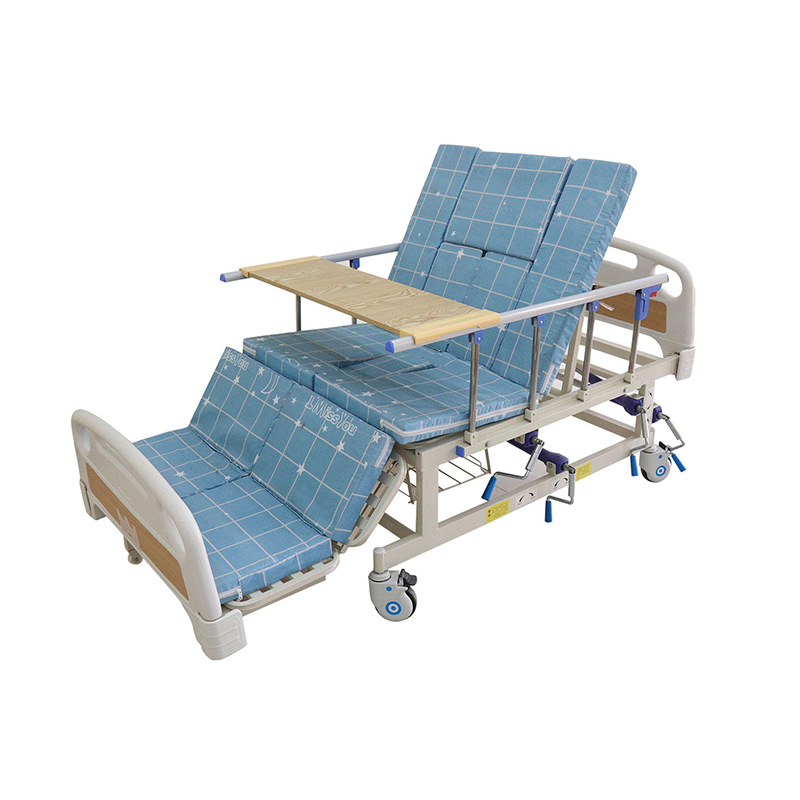
A side rail is positioned beside the mattress and mainly creates a protective boundary around the patient. An accessory rail is normally positioned lower on the bed frame and is intended for equipment attachment.
This distinction matters when reading quotations. A supplier may include side rails as standard equipment but offer accessory rails separately. Buyers should therefore confirm both items.
What Is an Accessory Rail Used For?
The accessory rail gives hospitals a practical place to mount items that might otherwise hang from unsuitable parts of the bed or occupy nearby furniture.
Its exact use depends on the department and the accessories approved for the bed.
Holding Drainage and Urine Bag Accessories
One common use is supporting urine bags and other drainage-related accessories.
Drainage systems often need to remain below the patient while tubing stays reasonably organized. A dedicated holder or hook can help prevent the bag from being placed on the floor or attached to a moving component.
Some hospital beds already include urine bag hooks on both sides of the frame. In other configurations, a drainage holder is mounted on the accessory rail.
For purchasers, it is useful to ask whether these hooks are integrated, rail-mounted, or supplied separately.
Supporting Cable and Tube Management
Modern hospital beds are often surrounded by cables, tubing, controllers, and external equipment. Poor organization can make inspection more difficult or interfere with bed movement.
Compatible hooks or holders mounted on the rail can help organize selected cables and tubes. However, enough slack must remain for height adjustment, backrest movement, patient transfer, and equipment relocation.
Hospitals should therefore use approved attachment points rather than improvising with random frame parts.
Mounting Baskets, Holders, and Brackets
Depending on the manufacturer, the rail may also support baskets, document holders, catheter holders, equipment clamps, oxygen-cylinder brackets, or other bedside fittings.
Why Is an Accessory Rail Important for Hospital Workflow?
A hospital bed rarely operates by itself. Caregivers work around it while managing positioning, drainage, oxygen, monitoring, cleaning, transport, and other tasks.
A well-planned accessory system gives selected items more predictable locations.
It Helps Reduce Bedside Clutter
Loose equipment can occupy bedside tables, hang from side rails, or remain close to the floor. An accessory rail creates another organized mounting area without using the mattress platform.
It Supports Flexible Bed Configurations
Not every department needs the same accessories.
A hospital may purchase one basic bed platform and configure it differently for general wards, recovery rooms, nursing areas, or long-term care.
Where Is the Accessory Rail Located?
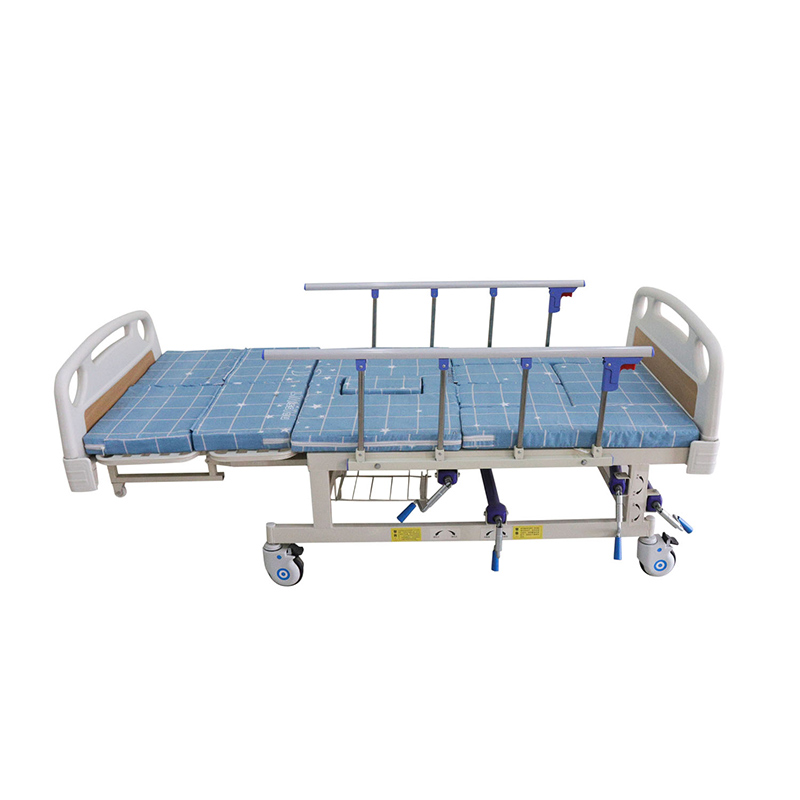
Accessory rails are commonly fixed to the lower side frame, but there is no universal position.
Some rails are close to the head end, others near the foot end, and some run along a longer part of the frame. Certain beds have rails on both sides so equipment can be positioned according to room layout.
Why Rail Position Matters
Electric beds may include backrest adjustment, leg adjustment, height adjustment, Trendelenburg positioning, or reverse Trendelenburg positioning.
The rail and attached accessories must not interfere with these movements.
For example, a bag mounted too low could contact a caster or the floor when the bed is lowered. A bracket positioned too close to a linkage could obstruct movement. Tubing without enough slack could become tensioned during adjustment.
Therefore, buyers should evaluate rail position together with the bed’s full movement range.
Are Hospital Bed Accessory Rails Standardized?
Not always.
Some hospital beds use DIN-style accessory rails, while others use manufacturer-specific profiles, tubes, brackets, hooks, or sockets. Visual similarity does not guarantee compatibility.
Rail Dimensions Affect Compatibility
Many accessories attach through a clamp or bracket. The clamp must match the rail width, thickness, and shape.
If the profile is different, an accessory may not lock securely even if it appears to fit.
For this reason, distributors ordering replacements should not rely only on terms such as “standard rail.” They should request actual dimensions, drawings, or confirmed accessory codes.
Accessories Are Not Automatically Interchangeable
A holder designed for one bed brand may not fit another. Even within one manufacturer, different models can use different mounting locations or interfaces.
Before ordering, purchasers should confirm the bed model, rail dimensions, clamp type, accessory code, and required load.
What Materials Are Accessory Rails Made From?
Accessory rails are normally made from metal because the mounting point must remain stable during repeated use.
Depending on the design, stainless steel or coated steel may be used.
Stainless Steel and Coated Steel
Stainless steel is commonly chosen when corrosion resistance and frequent cleaning are important. Its smooth surface can also work well with removable clamps.
Coated steel can provide practical performance when the finish and structure are suitable for the intended environment.
Buyers should check not only the material name but also rail thickness, fixing method, surface finish, and how repeated clamp use may affect the rail.
How Does an Accessory Rail Affect Cleaning and Maintenance?
Hospital equipment is cleaned frequently, so rail design should not create unnecessary maintenance problems.
A rail should be accessible for wiping and inspection, while mounted accessories should be reasonably easy to remove when necessary.
Removable Accessories and Replacement Parts
If baskets, holders, or clamps can be removed without dismantling the bed frame, cleaning and replacement become easier.
At the same time, removable parts should lock securely during normal use.
Hospitals often use beds for many years, so buyers should ask whether hooks, clamps, brackets, baskets, or complete rail assemblies can be purchased separately.
Что следует проверить покупателям перед оформлением заказа?
Accessory rails are relatively simple components, but they should still be included in the purchasing specification.
Confirm the Required Accessories
Start with actual clinical needs.
Does the hospital need only urine bag hooks? Does it need cable management, equipment baskets, oxygen-cylinder brackets, or additional holders?
Defining the accessory list first makes quotation comparison easier and prevents purchasing unnecessary components.
Ask for Dimensions, Material, and Load
Buyers should request rail width, thickness, length, material, mounting position, and recommended load.
If the hospital already owns accessories, these dimensions can be compared before ordering.
Heavy equipment should only be attached when the manufacturer confirms that both the rail and the accessory are suitable.
Check Whether the Rail Is Standard or Optional
Some beds include accessory rails as standard equipment, while others offer them as an option.
This can influence price comparison. When reviewing several quotations, buyers should ensure the same number of rails, hooks, holders, and brackets is included in every offer.
Can Accessory Rails Be Customized for Bulk Orders?
In some B2B projects, rail configuration can be adjusted according to purchasing requirements.
Possible changes may include rail length, mounting position, number of rails, hook quantity, material, or the accessory package supplied with the bed.
However, customization must be evaluated together with bed structure and movement. The rail should not obstruct side rails, casters, lifting mechanisms, cables, or patient transfer space.
For OEM projects, buyers should provide the intended accessory list, dimensions, drawings, and load requirements early in the discussion.
Is an Accessory Rail Necessary on Every Hospital Bed?
Нет.
A simple home care bed may need only a few hooks or basic attachment points. A general hospital bed may benefit from a more flexible rail system, while a higher-specification bed may require several accessory interfaces.
Instead of asking only whether a bed has an accessory rail, purchasers should ask which accessories need to be mounted and whether the proposed rail supports them safely and conveniently.
This makes the purchasing decision more closely related to actual use.
How Should B2B Buyers Specify Accessory Rail Requirements?
For bulk purchasing, rail requirements should be written into the technical specification or quotation request.
Useful details include:
- whether an accessory rail is required;
- quantity of rails per bed;
- left-side, right-side, or both-side installation;
- rail dimensions and material;
- required drainage bag hooks;
- required cable hooks;
- compatible baskets or holders;
- clamp or adapter requirements;
- recommended load;
- replacement part availability.
These details help buyers compare quotations accurately and help suppliers prepare the correct configuration before production.
Люди также спрашивают
Can an IV Pole Be Mounted on an Accessory Rail?
Sometimes, but not always.
Many hospital beds use dedicated IV pole sockets rather than mounting the pole directly on the accessory rail. If a rail-mounted IV pole holder is available, it should only be used when the manufacturer confirms compatibility and load requirements.
Can an Oxygen Cylinder Be Attached to the Rail?
Some bed systems provide oxygen-cylinder holders or brackets for approved mounting points.
Because oxygen cylinders are heavier than drainage bags or cable hooks, buyers should confirm the bracket, position, and load capacity before use.
Can Accessories Stay on the Rail During Bed Transport?
That depends on the accessory and bed design.
Some components may remain installed, while others may need to be removed or repositioned before transport, especially if they extend beyond the bed frame or could interfere with doorways and surrounding equipment.
Заключение
An accessory rail on a hospital bed is a practical mounting point for compatible bedside accessories. It can support drainage bag holders, cable hooks, baskets, equipment brackets, and other approved components. Its main benefits are better equipment organization, easier access, modular configuration, and greater flexibility across different care environments.
However, accessory rails are not automatically universal. Buyers should confirm rail dimensions, material, location, load capacity, clamp compatibility, cleaning needs, and replacement part availability before ordering.
For hospitals, private clinics, distributors, and medical bed purchasers, specifying these details early can reduce compatibility problems after delivery.
Jcare supplies hospital beds, home care beds, rehabilitation products, medical furniture, and related accessories for B2B customers. What accessories do you normally need beside your hospital beds? Feel free to share your requirements in the comments or pass this guide to colleagues preparing a hospital bed purchasing specification.