
Hospital bed buyers often see terms such as central locking, central brake, brake-and-steer, or directional locking without knowing how they differ. This can make product comparisons difficult and lead to the wrong caster configuration. Understanding the system helps buyers evaluate mobility, stability, maintenance, and daily staff operation more accurately.
A central locking system on a hospital bed is a linked caster-control system that lets caregivers operate the bed’s wheel brakes from one pedal or coordinated control point. Depending on the design, it may provide free movement, total braking, and directional steering modes. Its purpose is to secure the bed quickly when stationary and improve control during transport without requiring staff to operate each caster separately.
The basic idea is simple, but specifications vary. Buyers should understand the operating modes, caster structure, linkage, and intended use before ordering.
How Does a Central Locking System on a Hospital Bed Work?
A hospital bed must roll smoothly during transport but remain stable during rest, treatment, or transfers. Central locking helps staff switch efficiently between these conditions. Instead of operating separate wheel brakes, caregivers use a pedal linked to multiple casters through rods or other transmission components.
What Components Are Included?
A typical system includes medical casters, brake or brake-and-steer pedals, linkage rods, mounting parts, and caster locking mechanisms. Construction differs by manufacturer. Brake mode can restrict wheel rotation and swivel, neutral releases the system for movement, and steer mode may hold a designated caster in one direction while the wheel continues rolling.
Central locking is therefore a coordinated control concept rather than one universal layout. Buyers should ask which casters are controlled, whether steering is included, where the pedals are located, and what each pedal position does.
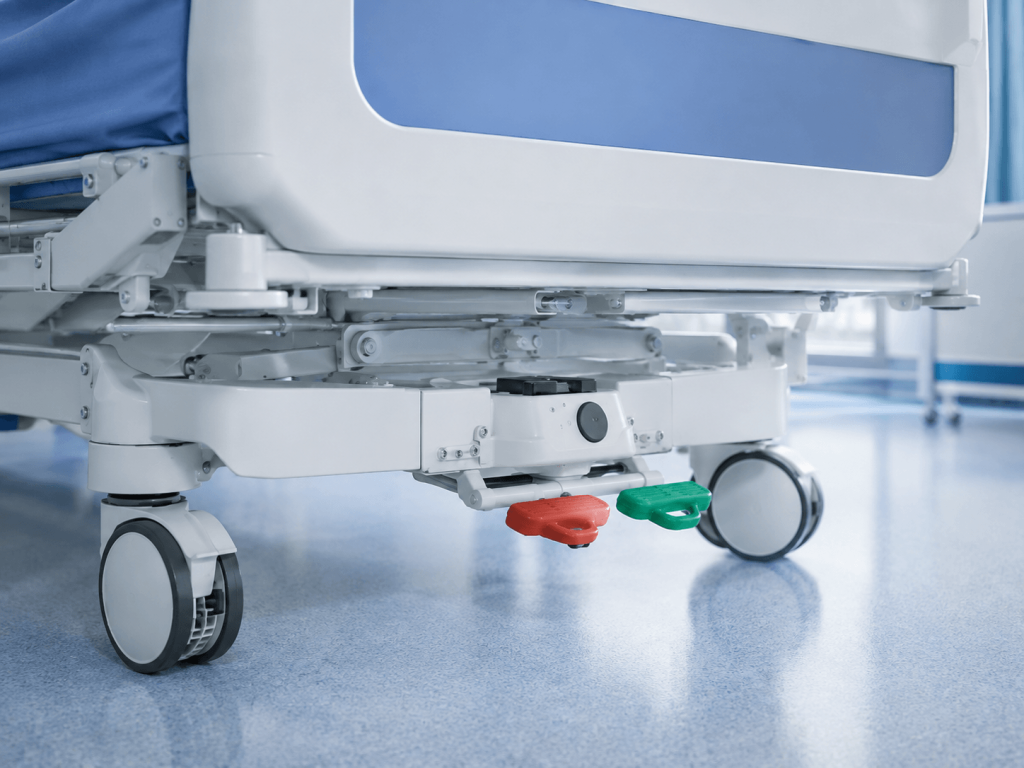
What Are the Main Central Locking Modes?
Many hospital bed systems can be understood through three operating conditions: brake, neutral, and steer. However, the exact functions should always be confirmed on the specific model.
Brake Mode
Brake mode is used when the bed must remain stationary. It may stop wheel rotation and caster swiveling, helping prevent unintended movement while a patient is resting, receiving treatment, or getting in and out of bed.
Manufacturer instructions commonly emphasize applying the brake whenever a bed needs to remain stable. Stryker documentation, for example, describes a central “Lock & Steer” pedal with a brake position for bed stabilization.
For buyers, brake performance should be physically tested. Pedal engagement, linkage response, and caster locking should feel consistent rather than loose or uncertain.
Neutral and Steer Modes
Neutral mode releases the coordinated lock so the bed can roll and swivel freely. This helps when turning in patient rooms, passing through doorways, or entering elevators.
Steer mode serves a different purpose. It limits swivel movement on a designated caster while allowing the wheel to roll, improving straight-line tracking. Medical caster suppliers commonly distinguish total locking from directional locking for this reason.
A bed moved frequently through corridors may benefit more from steer control than one that remains mostly in the same room.
Why Is Central Locking Useful in Daily Hospital Work?
The main advantage is faster switching between mobility and stable positioning. Hospital beds may be moved for cleaning, patient transport, equipment access, or room reorganization. Operating several separate caster brakes adds steps every time.
Faster Bed Securing and Easier Transport
A coordinated pedal lets caregivers operate multiple brakes from one convenient position, simplifying bed positioning and securement. It may also reduce the chance that one individual brake is overlooked, although normal safety checks remain necessary.
During transport, neutral mode supports flexible turning while directional mode can improve straight-line tracking. Some medical-bed systems specifically combine central stabilization with directional caster locking for easier transport.

Central Locking vs. Individual Caster Brakes: What Is the Difference?
Beds with individual brakes require staff to operate each braking caster separately. This can be suitable for simple beds moved infrequently, but it creates a different workflow from a centrally controlled system.
With central locking, multiple caster functions are mechanically coordinated so one pedal can control several casters, depending on the design.
When Is Central Locking More Valuable?
A basic manual bed used mainly in one location may be suitable with individual brakes when they meet the intended use. Central locking becomes more valuable when beds move regularly, staff need quick brake access, or directional control matters.
Purchasing teams should therefore compare movement frequency, ward layout, patient transfers, expected load, staff workflow, maintenance capability, and spare-part availability rather than initial price alone.
Does a Central Locking System Improve Hospital Bed Safety?
A central locking system can support safer operation by helping stabilize the bed, but it does not replace staff procedures or preventive maintenance.
When a patient sits on the bed edge, transfers to a wheelchair, stands up, or returns to bed, unintended bed movement can create risk. A properly engaged braking system helps keep the bed stationary. Stryker operating guidance instructs users to apply brakes when a patient is on the bed or entering or exiting it and to verify secure braking after engagement.
Why Maintenance Still Matters
Central locking depends on connected mechanical parts. Worn casters, loose linkage, damaged pedals, or incorrect adjustment can reduce performance. Routine inspection should confirm positive pedal engagement, correct caster response, proper neutral release, and normal steering. Buyers should also ask how the system is adjusted, serviced, and repaired.

What Should Buyers Check Before Ordering?
A good purchasing specification should describe the required function instead of simply stating “central locking.” That phrase alone may leave important technical questions unanswered.
Check Caster Size, Material, and Load Capacity
Buyers should confirm caster diameter, wheel width, tread material, mounting dimensions, and rated load. Load evaluation should consider the full working condition, including the bed frame, mattress, patient, accessories, and other supported equipment.
Wheel material can influence noise, floor protection, traction, wear, and cleaning resistance. The selected caster system should match the hospital environment and applicable destination-market requirements.
Check Pedals, Linkage, Cleaning, and Spare Parts
Because central locking relies on coordinated mechanical action, installation quality matters. Pedals, rods, caster stems, and connections must align correctly. During inspection, operate the pedal repeatedly and watch the controlled casters; engagement should be consistent without binding, looseness, or abnormal force.
Buyers should also ask about cleaning, maintenance intervals, replacement procedures, and spare parts. For large tenders, long-term serviceability can be as important as initial price.
How Should Buyers Test Central Locking Before Shipment?
Pre-shipment inspection should verify real operation rather than only confirm that the specified caster model is installed.
What Should a Functional Test Include?
First, place the bed on a suitable surface and test free rolling in neutral mode. Push, pull, turn, and change direction. Movement should be smooth without unusual resistance.
Next, apply brake mode and confirm that the bed is stabilized as intended. Test every available pedal and check that the connected casters respond consistently.
If the bed includes steer mode, move it along a straight route and confirm that directional control engages and releases correctly. Repeat the brake-neutral-steer sequence several times because intermittent linkage problems may not appear during one cycle.
Finally, inspect mounting points, rods, pedals, fasteners, and accessible connections. For bulk orders, these checks can be written into the purchase order or quality-control checklist so the supplier and inspection team use the same acceptance criteria.

What Questions Should Hospital Bed Buyers Ask Suppliers?
Specific questions are more useful than simply asking whether the bed “has central locking.”
Ask which casters are controlled by the system, whether braking stops wheel rotation and swivel, whether directional steering is included, and where the pedals are positioned. Also confirm caster size, material, load rating, maintenance requirements, replacement parts, and technical documentation.
For international sourcing, buyers should confirm applicable testing, labeling, documentation, and destination-market requirements.
For Jcare hospital bed projects, purchasers can define the caster system together with bed functions, load requirements, side rails, accessories, packaging, spare parts, and inspection criteria. This helps hospitals, clinics, distributors, and medical-bed buyers compare actual configurations rather than model names alone.
人々はこうも尋ねる
Do All Four Hospital Bed Wheels Lock With One Pedal?
Not always. Many central locking systems coordinate several or all casters through one control, but the exact configuration depends on the bed. Buyers should ask which casters are braked, which caster provides directional control, and what each pedal position does.
Is a Central Locking System Electric?
Usually, the caster locking mechanism is mechanical even when the hospital bed itself is electric. The pedal operates a linkage connected to the casters, while powered functions such as backrest, leg-rest, or height adjustment use a separate electrical system. Designs can vary.
What Is the Difference Between Brake Mode and Steer Mode?
Brake mode is intended to keep the bed stationary. Steer mode helps the bed travel in a more controlled direction while moving. A designated caster may be held in one swivel direction while its wheel continues to roll.
Can Central Locking Casters Be Replaced?
Yes, but compatibility involves more than matching wheel diameter. Mounting dimensions, stem design, overall height, linkage interface, operating angle, load rating, brake function, and steering configuration may all need to match.
For fleet purchasing, requesting replacement caster part numbers and spare-part information before the first order can simplify future maintenance.

結論
A central locking system on a hospital bed is a coordinated caster-control mechanism that helps staff switch efficiently between stable positioning and mobile operation. Depending on the design, one pedal can control braking across multiple casters and may also provide directional steering.
For buyers, the important question is not simply whether “central locking” appears on a specification sheet. Confirm the operating modes, controlled casters, pedal locations, caster size and material, load capacity, linkage quality, maintenance method, replacement-part availability, and inspection requirements.
Before placing a bulk hospital bed order, test the actual brake, neutral, and steer functions whenever possible. A well-matched system can improve bed handling, simplify staff operation, and support reliable daily use.
Which caster feature matters most in your hospital bed market: central braking, directional steering, quiet movement, or easy maintenance? Share your experience in the comments, and send this guide to other medical-equipment buyers who may find it useful.